There are a lot of ways for a child to learn a second language now. They can watch shows in Spanish, listen to Chinese songs, go through vocabulary flashcards, play language-learning games, or take classes after school.
But there is one thing that’s surprisingly hard to get enough of: actually talking.
It’s especially noticeable with kids learning a language their parents don’t speak. A child might have Spanish class twice a week and listen to Spanish at home, but who are they supposed to speak Spanish with on Tuesday night?
Even heritage-language families run into a version of this. Their child might hear Mandarin from their parents every day and understand almost everything, but answer every question in English.
We kept coming back to this when we started working on Phoenyx. There is so much language content for kids. There are far fewer opportunities for a child to actually have a conversation.
And there is some really interesting research on what changes when you add that conversation.
What happens when a story talks back?
Dr. Ying Xu has spent years studying how children learn with conversational AI. In one of her studies, preschool-aged children listened to stories with a conversational agent that didn’t just tell the story and move on. It stopped and talked to them about what was happening.
The children had to respond.
That sounds like a small difference, but the researchers found differences in how the children engaged with and understood the stories. Children interacting with the conversational agent made more relevant comments about the story and showed better comprehension than children who experienced the story without the same back-and-forth interaction.
What we find interesting isn’t really the fact that the character was AI. It’s what the AI made possible.
The child wasn’t just receiving information anymore. They had to participate.
If a character asks, “Why do you think the bear is sad?”, the child has to think about what happened, find the words for an answer and say them. Then the character can respond to what they actually said.
That’s a very different experience from watching the bear be sad on a screen.
And for language learning, that difference becomes especially important.
Knowing a word isn’t the same as being able to use it
A child can recognize rojo when they hear it without being able to remember rojo quickly enough when someone asks what color they want.
Those are different kinds of practice.
Listening to a Spanish story can help a child understand Spanish. Singing a Mandarin song can introduce new words. Flashcards can help a child recognize vocabulary. All of those things can be useful.
But eventually, if we want children to speak a language, they need chances to speak it.
They need someone to ask them a question and wait for the answer. They need to search for a word and sometimes get it wrong. They need to start a sentence in Spanish, get stuck, throw in an English word and keep going. They need to tell the same story badly a few times before telling it well.
A weekly lesson can provide some of that. A bilingual parent can too. So can grandparents, friends, babysitters and immersion schools.
The hard part is getting enough of it.
This is the part of AI we’re excited about
There are plenty of things we don’t think children need AI for. We don’t want Phoenyx to replace a parent reading a bedtime story, a conversation with Grandma, or playing with another kid.
But AI can do something that, until pretty recently, was difficult to make available to a child whenever they wanted it: it can listen and talk back.
That’s what made us interested in conversational AI for language learning in the first place.
Phoenyx can ask a child what they’re drawing and then ask why they made the sun purple. It can tell a story and stop to ask what they think should happen next. A child can ask it for a joke, change their mind and play a game instead. If they answer with one Spanish word, the conversation can keep going. If they’re more advanced, the conversation can become more complicated.
And they can do that again tomorrow.
We care a lot about the “again tomorrow” part. Learning to speak isn’t one big breakthrough. It’s lots and lots of small moments where a child has to find the words themselves.
Sometimes that conversation lasts three minutes. Sometimes a child gets completely absorbed in telling Phoenyx about their toys. Sometimes they spend most of it speaking English and manage a few words in Mandarin. Those few words still required them to speak.
AI doesn’t need to replace the way kids already learn
The most exciting version of this, to us, isn’t a future where children learn languages entirely from AI. It’s much more ordinary than that.
A child learns a song from their grandmother and sings it with Phoenyx later. They learn new words in Spanish class and then actually use them while playing a game at home. They draw a picture while talking to Phoenyx about what colors they’re using. They get comfortable saying a phrase with Phoenyx and eventually use it with someone else.
The people, books, classes, songs and culture are still there.
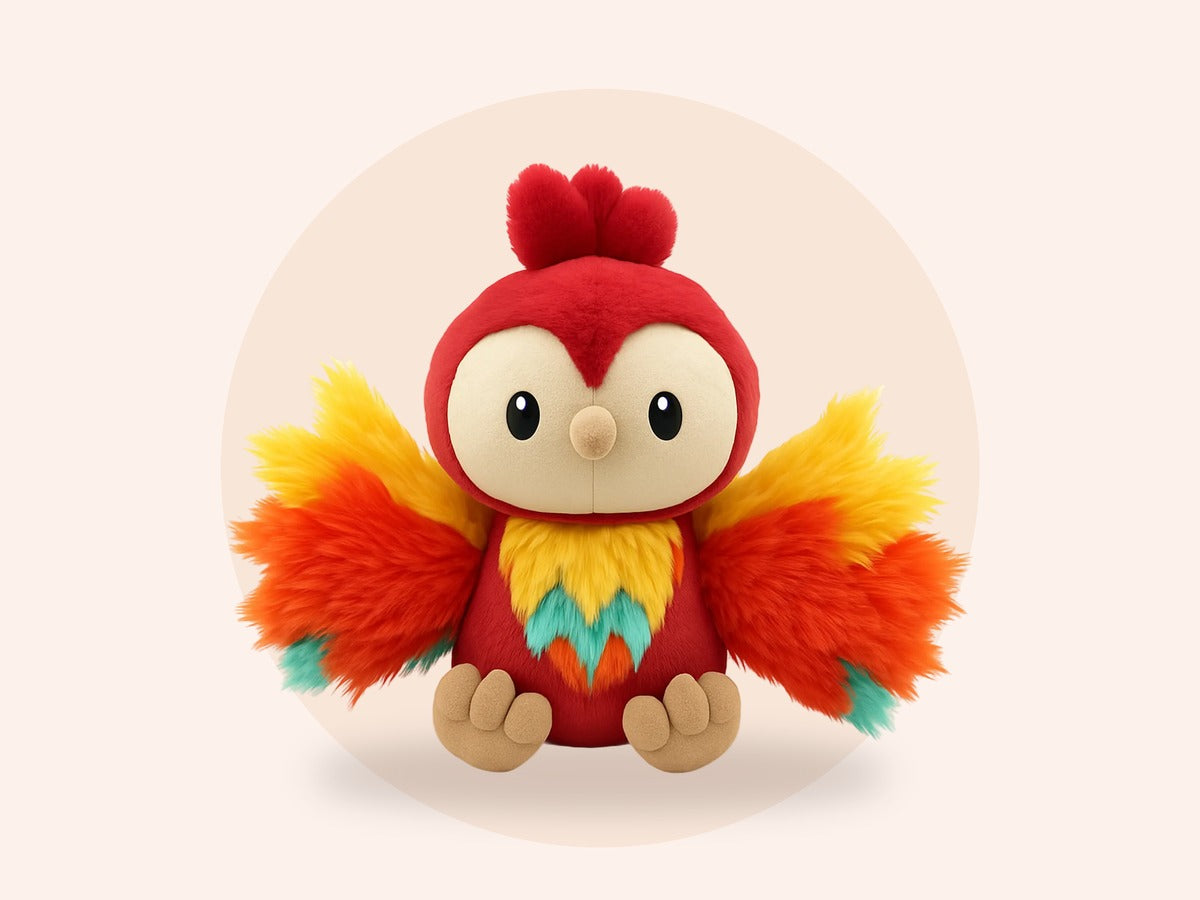
AI just gives the child one more person—or in this case, one little stuffed bird—to practice talking with.
That’s the part of conversational AI we think is genuinely new. For the first time, giving a child another conversation doesn’t necessarily mean finding another adult who speaks the language, scheduling another lesson, or putting them in front of another screen. They can just squeeze Phoenyx and start talking.